


Happy new year, everyone. Welcome to 2025. Let’s start at the very beginning…
What comes first when you set out to write a story? The characters or the plot? Do you say something like “I’ve got this rich playboy…”? Or do you say “There’s this company taking over another…”?
For more guidance how to begin, choose your own adventure below…
Character first

The truth of the matter is setting out to write a story, you need characters. You’ve got them all around you, so if this is what you came up with first, it’s a perfect place to start.
But you also need what I call an inciting incident. An inciting incident is an event that sets the main character’s comfortable situation into crisis or disarray.
For example, the playboy’s father demands he settle down and marry — or his expectation of taking his place on the board will go down in flames at the next annual board meeting.
The plot goes forward from that point. You’re going to follow how the playboy sets about trying to remedy the inciting incident and get what he wants. He starts out motivated by money (preserving the status quo of his allowance and being able to maintain his playboy ways). He begs Dad, he tries to talk to someone on the board he thinks is sympathetic, etc. Unable to come up with other options, he pays a woman he meets at a bar to pretend to be his fiancee. Each of those attempts are scenes in your story. He brings her around, suggests to Dad that they’ve been around together, he just didn’t want to make a big deal about it. The two attend all sorts of functions, the father judging all the time.
The story builds to the climactic moment our playboy’s father pays off the woman and tells her not to darken their doorstep ever again. But of course, now, the playboy’s been around this woman so much he might actually be falling in love with her. So, motivated now by the possibility of losing her, he goes after her and lets the board vote happen without his presence because he now cares more about her than about the money or position.
Plot first
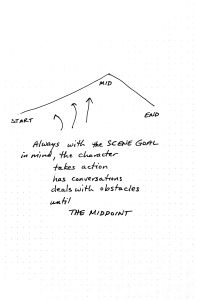
If you have a plot idea in mind first, that’s perfectly okay, too. But every plot needs characters who will act in it. For the corporate takeover plot, you consider who’s on the takeover team at the bigger company, and who’s on the response team at the company about to be glorped. Then you have to give the primary opponents (the leaders of these two teams) motivation, personal reasons they stand on the side of the issue that they do.
For example, the lead exec on the takeover team is hoping for a promotion to a higher executive position, and has been told they’ll get it if they succeed. The lead exec at the company about to be taken over had just set in motion plans to buy a house, which without a job, they’ll no longer be able to afford. So, you ask why does the characters need/want a specific outcome. The characters’ motivations will drive all their choices, while the situation additionally puts them at odds. So you get both internal and external conflict in every scene.
Where to begin
Whether you are starting with character or the plot, the fact of the matter is you need to set both up during the opening pages of the story. If the characters are going to be upset from their normal, you have to show readers what that normal is or was. But you can’t spend pages doing that. Readers today prefer to dive right into the plot and get the character background and details of their motivations revealed over time, rather than all upfront. There’s little tolerance for extensive stage-setting.
You have three choices to get this done:
- Illuminating a few regrets while the inciting incident is unfolding.
Carter stood at the head of the table. “The executive board agreed to hear their offer,” he said.
Valerie felt the blood drain from her face. She was supposed to be at the realty office to sign the papers on the house today. - Or reference a scene that occurred before the story opened.
He walked into the study, taking off his jacket and handing it to the butler who wrinkled his nose. Probably smelled the lady’s perfume. Ah well, couldn’t be helped. Daddy’s text summoning him had disrupted a rather delightful morning after the night before. - Or have the antagonist tell the main character outright that their wants/needs are not going to be met.
“I will be 60 next week, my boy. I expected grandchildren already. You want the board position? Get married and settle down.”
Or, you might use all three.
Happy writing!
~ Lara
PS – Editing availability begins in March 2025, so if you think you’ll need editing, better to schedule with me now.
For form, click ad

For info on the workshop, click ad
January’s writing prompt:

Discover more from LZ Edits | Editing Services
Subscribe to get the latest posts sent to your email.
 LZ Edits | Editing Services