

Is using “said” dialogue tags good or bad? What about using “snapped” “shouted” “whispered” or “questioned” or even the many adverbs often added to said, like “laconically” “dramatically” or “softly”?
I’ve talked before about attributions in dialogue, so what I want to do today is drive home the idea of making your dialogue so sharp, so uniquely “in character” that it does not need attribution or adverb qualifiers.
Carefully chosen words
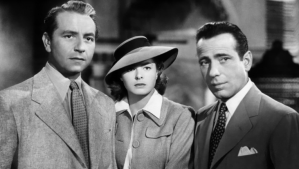
“Of all the gin joints in all the towns in all the world, she walks into mine.” While you may not know this famous line spoken by Humphrey Bogart’s character Rick Blaine in the romantic World War II movie Casablanca, I’m going to break it down and show what it reveals about Blaine and thus why it is a line of dialogue that can only be spoken by him.
We have “walks into mine” connected to “gin joints” thus making it clear that the speaker is the owner of a bar. We also can understand that the owner, whatever the actual state of the bar, likens it to a “gin joint.” Parlance that is particular to a profession, time and/or place instantly gives dialogue both character AND setting.
Referring to his place of business as a “gin joint” shows Blaine is a realist. He does not refer to his place as a club, or a resort, or conversely, so low as to be a “watering hole” or “dive.” He’s under no illusions that his business is a fancy place. It’s a bar and it makes him a living, if he can keep things real. He has a blue collar attitude, even if he’s wearing a suit.’
This line also does not need any adverbs to describe how he’s speaking. The cadence of the words, where the commas separate the phrases, and the meaning show that his tone is depressed.
Another character
Victor Lazlo, played by Paul Heinreid, is Blaine’s opposite in Casablanca: a dreamer and an outspoken Resistance leader. No wonder his dialogue is also filled with dream-language, high-ideals, fighting words: “You might as well question why we breathe. If we stop breathing, we’ll die. If we stop fighting our enemies, the world will die.” His hyperbole and metaphors show he envisions himself a dam against the march of the Nazis designs to take over all of Europe. One man against a million. Well, not just one man. He’s not that far gone. He does use “we.” “We” makes a group out of individuals, establishing the speaker is united with the audience in a common cause.
The more unique word choices you can bring out in your characters’ dialogue, the more likely you won’t need to identify for the reader who is speaking.
Unnecessary attribution breaks flow
If you’re coming to the end of a piece of dialogue and feeling like you have to tack on an attribution: X said, ask yourself if there’s something you can do to make the dialogue clearly attributable to the speaker in another way. Here are some options:
Option 1 – use dialect
Used sparingly, apply dialect. Really write how the character speaks. Many people are “sloppy” with their words, while others are painstakingly formal to show themselves to their listener as being a particular way. You can go droppin’ the g on a word, running together words the speaker would blur: “whatcha doin’,” or even “what’re you doin’?” or “I gotta” or “Dinna ye mind.” You can also meticulously elongate words the speaker stresses: “I lo-ov-ve rhubarb pie.”
Do not overuse. Remember dialect is more than mixed and mingled words we all speak. It is also unique words: interjections, regionalisms, aphorisms, and idioms: “Gawrsh, Mickey, whatcha gonna do?” (Goofy) “The aviary walk is notable for its beautiful birds of all species.” (a zoo guide)
Option 2 – use quick attribution
Early in long dialogue, you can put simple attribution. The sooner you identify the speaker for a reader, the sooner they can hear his (or her) voice in their head with the words on the page. But keep it short: “he said” or “[name] said.” Then roll on with the rest of the dialogue. Be wary of breaking the flow of a scene’s tone. Put the attribution at a logical break where the speaker might take a breath.
“Stop,” Lem said, “look at me when I’m talking to you. This isn’t about what you want. It’s about what I want and I won’t have you telling everyone here my business.”
Option 3 – use action by the speaker
The last option is not to use a dialogue tag at all, but describe the speaker’s actions. Dialogue tags, even short ones, can break the flow of the scene for the reader. If that’s the situation you want to avoid, look at putting the speaker’s actions into the paragraph with their dialogue.
In the crowded room, James started to open his mouth, determined to get above the din. A hand landed on his arm.
“Stop”–Lem drew him to the side of the aisle among the shadows along the wall–“Look at me when I’m talking to you. This isn’t about what you want. It’s about what I want and I won’t have you telling everyone here my business.”
You can also write full sentences, and separate the action as its own sentence. Notice how the cadence of this contrasts with the version above:
“Stop, look at me when I’m talking to you.” Lem drew him to the side of the aisle among the shadows along the wall. “This isn’t about what you want. It’s about what I want and I won’t have you telling everyone here my business.”
Whatever your choice, remember dialogue is a way for your readers to get to know your characters, feel like they’re right there, talking in front of them. Make the dialogue meaningful for the situation and real in the way that people speak, and you’ll immerse readers in the world of your characters quickly and completely.
Remember: a reader who reports a “book hangover” from your book means you’ve done fabulously in the character and world-building department, and dialogue is an integral part of that.
~ Lara
Discover more from LZ Edits | Editing Services
Subscribe to get the latest posts sent to your email.
 LZ Edits | Editing Services