When hiring any professional, you should plan to have, first and foremost, a professional relationship. You should find someone who understands the value of time, both yours and theirs, and is willing to make a commitment to you in writing, detailing the tasks and responsibilities, milestones and deadlines, responsibilities and expectations. There should be an attitude of flexibility, but also a willingness to set and adhere to a standard that creates a quality product for you and your readers.
Here are 15 questions that you should ask any editor you are considering. (My answers are below)
- When should I hire an editor?
- What training and experience do you have?
- Which categories of books do you work with?
- What services do you offer?
- How much will an editing service cost?
- Do you do sample edits?
- Can I have a reference from other authors you have worked with?
- Do you have a contract or set of terms and conditions which includes a confidentiality clause?
- Can we speak on the phone or via Zoom?
- Can I ask follow-up questions after the edit is completed?
- What format should my manuscript be in?
- What tools do I need to use to work with you?
- How long will the edit take?
- Can you help me write a pitch letter/find an agent?
- I’m not ready to hire you just yet. How do I keep in touch?
And here are my answers…
When should I hire an editor?
As soon as you have a complete draft – or know when you will finish your first draft of your story.
While developmental editing can be done on an incomplete project – since sometimes the service is “help me figure out how to finish this” – all other editing, copy editing, and proofreading, are done only on completed manuscripts. The highest quality editors cannot fit you in right away and with a contract in hand you’ll know how much you’ll have to save and have the time to do so.
A lead time of at least two months is beneficial for both you and the editor. While you are waiting for your slot, you can get feedback from beta readers and make revisions of your own, AND also work on marketing items for indie publishing like writing your blurb and hiring your cover artist.
Here is a timetable I have found works well.
What training and experience do you have?
There is both formal and informal training. Formal training can include degrees and certifications. Informal training can be doing beta reading and self-study in grammar courses and editing. The number of years and total projects in that time can demonstrate consistent growth in an editor’s skills. There are professional organizations for editors, though at this time, most do not require vetting, but only a membership fee. But being part of such an organization means the editor desires to associate with other editors, network, and often attends seminars as a form of continuing education.
I have been editing stories and books for indie authors, in many genres, for more than 15 years. I began as a beta reader, then formalized my education in writing and editing. I have a bachelor’s degree in print journalism and a graduate certificate in professional writing. I certified in developmental editing, book coaching, copy editing, and proofreading. I teach writing workshops and host a writers group on Zoom most weekends. I am a member of LGBTQ+ Editors Association, Romance Writers of America and Rainbow Romance Writers chapter, Golden Crown Literary Society, Opus Literary Alliance, and the Editorial Freelancers Association. I’ve been a mentor and guide to new writers in RWA’s RAMP and Pen to Paper programs and a judge for the GCLS Goldies and the Bi-Writers Association Bi+ Book Awards.
You can read more about my experience here.
Which genres of books do you work with?
I have edited over 200 manuscripts in a wide variety of genres. I can and will copy edit or proofread any genre except horror. I have helped authors develop YA, NA, and adult stories of adventure, fantasy, science fiction, historical, women’s fiction, and romance. I have edited the full spectrum of erotica and erotic romance, from sweet through 5 chili peppers. I have edited stories centered around BDSM and other kinks as well as stories with group sex and polyamory (aka “why choose”). The lion’s share of my clients write some subgenre of romance.
You can see a sampling of my clients’ titles here.
What services do you offer?
I offer services that will get you from incomplete, or even blank page, to a publication-ready story. manuscript evaluations, developmental editing and coaching, copy/line editing, proofreading, and book formatting.
From time to time, I also offer multi-week workshops and one-day 2-3 hour seminars on specific topics in writing or self-editing.
How much will an editing service cost?
My services start at $4 per 1,000 words (a manuscript evaluation) to $15 per 1,000 words (a developmental edit and coaching package). My most popular service is copy/line editing, which is priced at $8 per 1,000 words. My pricing is clearly marked on each page describing the service.
Do you do sample edits?
Yes, I do sample edits. You can send up to 1,500 words (which should be most, if not all, of one scene) to accompany your request for service.
I prefer to edit a scene from Chapter 4 or 5, to get the meat of your storytelling style. Initial chapters often are heavy in exposition. A scene from Chapter 4 or 5 will often have a good mix of dialogue, description, and a clear sense of your point of view choice.
Can I have a reference from other authors you have worked with?
I will happily connect you with a prior client who writes in the same or similar genre, but you are also welcome to contact any author directly through their book links on my client books page.
Do you have a contract or set of terms and conditions which includes a confidentiality clause?
Yep, my contract contains a confidentiality clause as well as a disclaimer that states the work remains at all times the copyrighted property of the author and I will not lay claim to any part. This goes for the developmental editing and coaching services as well. YOU do any rewriting or new scene writing. It will always be your words, prompted only by my advice on how it might best be improved.
Can we speak on the phone or via Zoom?
Since I work with clients all over the world, Zoom is my phone. Prospective clients can schedule a free 30-minute Zoom consultation.
Can I ask follow-up questions after the edit is completed?
I wouldn’t expect anything less. Edits are done with Track Changes because they are suggestions. While some edits are bound by grammar considerations, fiction writing is an art, not a science. Style matters. Your style matters. Your character’s voice matters. If you are curious about the why of an editing suggestion, you can contact me by email or Zoom and I will be happy to discuss the matter and come to a style standard (creating a style guide specific to your books) that will assure the changes are consistent.
What format should my manuscript be in?
For all editing, except proofreading, you will want to send me your manuscript on
- default page size (A4 or 8.5×11)
- double-spaced
- Set the margins at 1-inch (or 2 cm) on the top, bottom, right, and left.
- Indent paragraphs using the auto-indent of 1/2 inch (or 1 cm)
- Do not add an extra return (blank line) between paragraphs. And make sure that your paragraphs do not have space below them in the formatting dialog box.
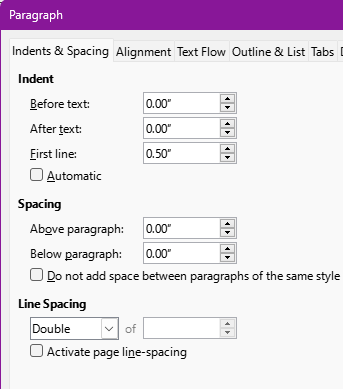
For proofreading, the story should be in a PDF or the pre-upload MS Word document (DOCX), where the page size, margins, fonts, alignments, indents and all graphics are all placed exactly as you plan them to be for publication.
What tools do I need to use to work with you?
You will want to have a copy of Microsoft Word or LibreOffice to be able to view the edits and comments and accept/reject them easily.
How long will the edit take?
The length of time an edit takes is directly related to the length of the manuscript and the type of editing requested. A typical copy edit of 75,000 words will take me three weeks. A 100k story will take 4-5 weeks to copy edit. I typically do what’s called two “passes” in that time. One pass focuses on clarity of ideas, and checks consistency of details about characters, setting, and plot. The second pass addresses sentence structure, grammar, punctuation, style, tone, and flow. A proofread or manuscript evaluation will often take about half the time of a copy edit. A developmental edit is a multi-phase package that including a manuscript evaluation, coaching, and finally, a copy edit and can mean a partnership of 3-4 months.
Can you help me write a pitch letter/find an agent?
I will edit pitches, blurbs, cover letters, and book summaries used for querying. However, I am not connected to any publishers or publishing agents. I have a background as a traditionally published author, though, and can have some insights on how to locate the best agents or publishers who work with your genre.
I’m not ready to hire you just yet. How do I keep in touch?
You can join my newsletter to get free writing and self-editing tips, updates on my availability, and recommendations on books that can help you improve your writing. There will always be a link to contact me in the footer.
 LZ Edits | Editing Services