
Today’s editorial advice is for authors writing synopses. If you are planning to traditionally publish, you have to query publishers or agents to see if they’ll pick up you and your work. What agents and publishers frequently request is a synopsis.
What is a synopsis?
A synopsis is a full summary of your story, from beginning to end. The end is very important. You are trying to show that you have a full command of all the elements of story:
- interesting, full-bodied characters
- situations and conflicts that fit the setting and sensibilities of the genre’s readers
- that you can give a story a satisfying ending
Your first three chapters will show if you have command of grammar and voice, so don’t use dialect or pretend you’re the Dungeon Master of a D&D campaign. Just talk about the character(s) and the plot simply and directly.
How to write a synopsis
The focus of a story’s plot arc is the main character(s), their goals, their motivations for those goals, and the conflicts they face. If you have one main character, who is also the only character whose point of view you share throughout, then this is straightforward:
- Start with a paragraph that explains who the main character is, what they want, and why they want it.
- Next paragraph, explain the first obstacle – or the antagonist – who stands in their way.
- In the next paragraph, group together the situations the character gets into and the other obstacles they face as they try to achieve their goal.
- Explain the climax
- Finish up with what the character learned about themself and the world around them, and what they’ve achieved.
There. It’s not quite a five-paragraph essay formula, but it should get you to tell the whole story, showing the publisher or agent that you know how to write the beginning, middle and end of a story.
What about multi-POV stories?
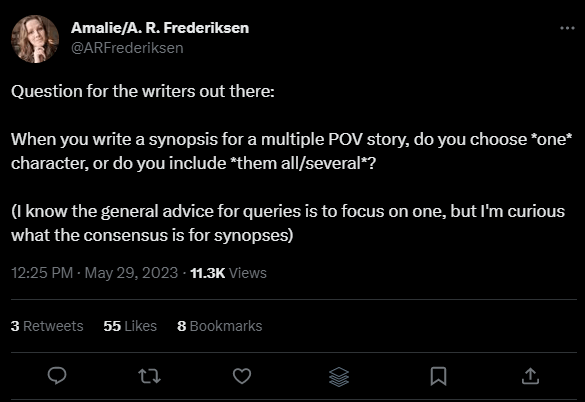
Here’s a tweet I found on Twitter the other day:
Question for the writers out there: When you write a synopsis for a multiple POV story, do you choose *one* character, or do you include *them all/several*? (I know the general advice for queries is to focus on one, but I’m curious what the consensus is for synopses)
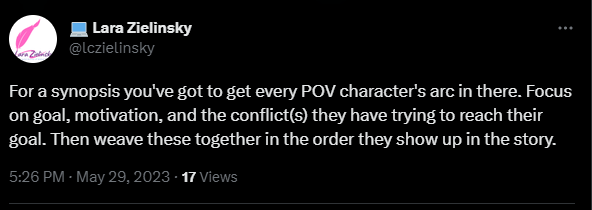
I quickly replied: For a synopsis you’ve got to get every POV character’s arc in there. Focus on goal, motivation, and the conflict(s) they have trying to reach their goal. Then weave these together in the order they show up in the story.
Problems
What will often trip up a writer is this idea that every POV character has a goal, motivation, and conflicts. But if you’ve chosen to put the reader into the perspective of a character, they should have an agenda all their own. They want something and they pursue it for their own reasons, and they will then face conflicts and obstacles trying to get that thing for themselves.
This is easy to see when you have given the antagonist point of view for several scenes. You’re showing they want something, and their reasons, and how the protagonist is in their way.
A cat-and-mouse thriller exactly demonstrates this. Think how In the Line of Fire spent time demonstrating both the Secret Service agent’s (Clint Eastwood) goals and motivations AND the ex-CIA agent’s (John Malkovich) goals and motivations. All those planning scenes where Malkovich is setting up the bank accounts, killing the bank teller, pressing the flesh at a campaign event… are all his steps attempting to achieve his goal, and he deals with conflict from others in those scenes as well as from Eastwood’s character.
Any sidekick you decided to give POV to should also have their own goal, motivation, and conflicts. These separate goals and motivations will shape how and why they support (or break from) the goal the protagonist wants to achieve. Let’s go back to the movie In the Line of Fire. Rene Russo’s character is the sidekick. She’s in a position to be promoted to start managing the president’s detail, not just be a front-line agent. She wants this for her own reasons. When Frank (Clint Eastwood) seems to go off the rails, she makes some calls to rein him in, or keep him out of the loop. A sidekick’s goals, motivations, and conflicts, are often smaller and simpler than the protagonist’s. And, in the case of a book series, any of the sidekick’s bigger goals can be suffer delayed fulfillment, at least until the book where they get to be the protagonist.
If you have co-protagonists, such as in a romance or a buddy adventure, each one still has to have their own personal reason (motivation) for pursuing the common goal.-At times, their motivations may be called into question by others, or they have a secondary goal that no one else wants to pursue, or for which they’re ridiculed. In a romance, this leads to the “I thought you wanted us” line when MC1 has learned that MC2 made a deal behind their back, or was caught kissing another person.
For the buddy adventure, look at the foursome of friends going on a hunt for a body in the woods that Stephen King so aptly put forth in the short story “The Body” (which became the movie Stand By Me). Each boy has his own reasons, that have to do with their personal/home circumstances, for going on the trip. During the trip, these motivations occasionally make them make dangerous or stupid choices, trying to do something that will make them the well-remembered “hero.”
A self-check
As you are writing your synopsis, you may discover you have too many POVs if you can’t define a goal, motivation, and individual conflicts for every POV character, alongside the main goal. If so, you may want to revise/rewrite, or scrap scenes since they aren’t really helping you tell this story. It’s better to fix the situation now than have the publisher or agent reject your story when it has such structural issues.
~ Lara
If you’re in need of an objective analysis, I provide such a thing with my manuscript evaluation service. Feel free to hit me up for a quote. I’ll be happy to help.
Discover more from LZ Edits | Editing Services
Subscribe to get the latest posts sent to your email.


Another great article. Thank you!
LikeLike