
With the demise of NaNoWriMo, I’ve been seeing more communities spring up to support writers who still want to challenge themselves to write a novel (or at least 50k of one) during the 30 days of November. ProWritingAid has started a community for “Novel November.” I’m not a fan, because of the pro-genAI attitude of that company.
I do think community is important, so consider forming a small writing accountability circle with other (human) authors from your writing groups. Why small? Performative behavior is damaging to creativity. Writing to be able to post to 10,000 people–who probably won’t ever read your update–that you did isn’t as encouraging as two or three close writer friends who will respond “way to go!” whether your word count was twelve or twelve hundred. When so many ae “counting” on your word counts and you’re seeing so many others’ word counts, there’s great temptation to cheat, to fudge your numbers, or even stop writing when you aren’t meeting the collective daily goal. A small writing group will also give you support when you have to step away for two days because of a personal crisis. An algorithm doesn’t care. People do.
Writing advice
I’ve discussed pantsing before. But having an understanding of story structure, so that you might seek your way toward some “signposts” on this vast plain of inspiration, might be useful to keep you writing. After all, it is perfectly acceptable to write your novel by skipping around and writing a disjointed collection of scenes (two of my novels came about that way). You’ll write the connectors, ramps, and bridges after the story is at least a basic roadway–even if that zero draft road has potholes and some really wild left turns.
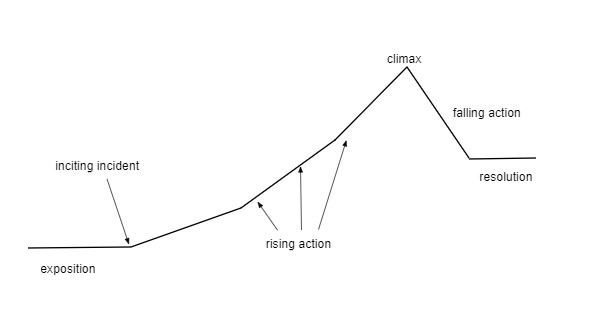
Exposition (2-5k)
As little as one or two scenes. While a final story might start right in the middle of the action, this is your chance to do some world-building and have it add to your word count. The details will likely get scattered to other scenes in the story, but writing your main character’s normal world. Remember the primary requirements of a scene: character goal and action.
In the exposition, you can introduce settings that will be frequented by the main character or the politics or social norms of the community in which they live. Introduce supporting characters for your main character, including family, friends, allies, and some enemies, but remember the focus is your main character, who they are, and what they want.
Inciting Incident (4-6k)
Two to three scenes. Goal 1: disruption to the character’s normal and threat to the story goal. Goal 2 (optional): a resistance to the necessary change or action, and Goal 3: a starting point of an idea or plan to reclaim normal.
Rising Action (24-40k)
There’s going to be easily 12-20 scenes here. This is the meat of the main character’s journey and will be multiple scenes with each incremental advance and set back as they try to follow their plan, make a new one, learn new things, discover lies that have governed their life, adjusting, trying on new truths, making new allies or new enemies, face opposition in situations, as well as a variety of people working at cross-purposes to them, and so much more.
Treat each as a mini-goal and include the planning, the execution and the consequences (positive or negative) before you have the character plan the next attempt forward.
Climax (4-6k)
Two to three scenes. A final threat to their new self–a threat from the past returning to be reckoned. Or a do-or-done meeting or confrontation that could end the main character’s path forward into a new life before it can really begin.
Falling Action (4-6k)
Two to three scenes. The main character recovers from the “battle” in the climax, whether that is physically or emotionally. There’s often a reconciliation scene with someone they inadvertently hurt or damaged as they were reaching for the goal. In romances, this is often the grand gesture. But it can simply be interpersonal work to repair a friendship or family relationship that was blown up on the way.
Resolution (2-4k)
One to two scenes. A new normal has been achieved and the main character may have moments of diffidence or discomfort, still finding their feet in this new normal, internally changed and grown because of all that has been experienced.
I’ve kept this as simplified and short as possible. For more reading about writing scenes, check out this post.
- What’s word (count) got to do with it?
- Structuring a Scene
- Scene building using goals
- Scene building: Beginnings
- Scene building: Middles
- Scene building: Endings
~ Lara
PS – Current clients, look for an email about booking for 2027. I won’t open to new clients until I know you all are at least penciled in.
Discover more from LZ Edits | Editing Services
Subscribe to get the latest posts sent to your email.

