
Today we’re going to discuss building compelling “middles.” Between the beginning and the end, most of the story happens. Popularly, the “muddled middle” or “the slog,” this is the bulk of your story’s plot before the climax. After the climax is generally the shortest part of your story, tying up loose ends, and characters patting each other on the back for a job well done. But that middle. Oh, that middle’s gonna take you places.

You want readers to stick with your story, and not feel a let down from your beginning. You also don’t want the situations in the middle to feel like characters are getting off too easy, or suffering impossibly hard. You want things complex enough to be interesting for the reader, but not so complex that only a deus ex machina is going to get the characters out of their pickle (or jam — pick your most apropos metaphor).
In my writers workshop Build-A-Book, we’re talking about middles this week, and my mantra is be “SMART” about it:
- SMART with your characters’ short-term, immediate scene goals
- SMART with the things they learn about themselves, others, and the situations at hand.
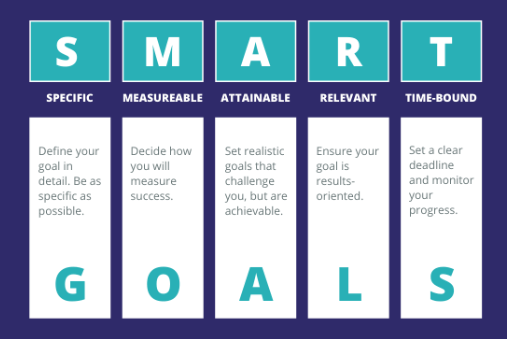
SMART is an acronym that should be familiar to many people. Referring to goal-setting (and since every scene should have a goal), it suggests that you define these goals as Specific, Measurable, Achievable, Relevant, and Time-based.
What this looks like for planning to write a scene is this:
- Specific – what do I want to show the character tangibly learning?
- Measurable – what will success look like? or partial success? or failure?
- Achievable – even if the character will fail, what will they see about the opportunity as achievable?
- Relevant – how is this learning or test going to move the character along toward their goal (success) or meaningfully push them off-path (failure)?
- Time-constrained – what about the goal is limited? Is it the setting? Is it the presence of specific characters (who won’t always be together)? Is there a deadline?
Too often we go for the high-brow goal: I want my character to learn that love can be kind and generous. And so, we have them see examples of kindness, and think about how they can be kind, and ponder the limits or conditions of kindness. But that means there’s seldom action. If you set the scene goal using SMART guidelines, you will show the character actively growing and changing.
4 Types of Scenes
The middle of a story is primarily filled with three types of active scenes:
- learning situations
- testing situations
- rewards
- consequence situations
Time for your character to go to school. The school of life. There’s learning, tests, rewards and consequences on their way to getting what they want (their story goal). Each scene will have them taking a small step forward, or backward.
1. learning
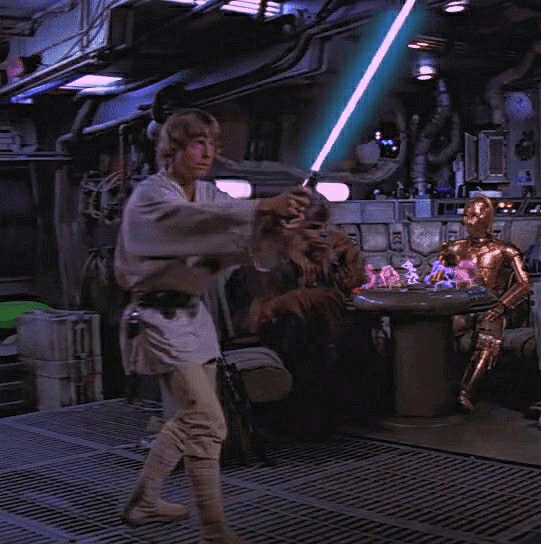
In learning scenes, the character is discovering something relevant to their goal – skills, facts, or even just viewing others. This is Luke learning about the Force, practicing with the lightsaber. There’s conflict – – Han doesn’t believe that “religious mumbo jumbo.” There’s also witnessing its application by others — “Obi-Wan force-pushing the Storm Troopers minds and feeling the deaths on Alderaan.
In each of these scenes, the character’s goal is more knowledge, but notice the scenes are active. Obi-Wan and Luke are actively engaged in a discussion, as he physically practices. Han argues. Things outside the discussion interrupt the learning, but provide Luke with more instruction.
2. testing
In testing scenes, the character thinks they know something and tries to apply it in a step toward their goal. Many times these scenes contain failures, or at least partial failures, that end up teaching a nuance to the learning. These scenes show that some skills are more useful in some situations, while other skills are more useful in others.

Back to to Luke in Star Wars. Luke learns that, even though he’s been physically honing his body in his training with Yoda, and that the Force can do some things, it’s not the solution to everything. Sometimes you have to “read the room” and use instincts that have little to do with either physical strength or the Force: his attempt to lift out the X-wing fighter from the bog, and his literal test inside the tree facing “Vader.” He fails at both tasks/goals, but he is trying to apply what he’s learned.
Tests can also be outward pushes to get back on track toward their big goals. They think “this is the rule, but what happens if I bend it in this way?” is also a valid test scene. Regardless of who sets the test, the end result, win or lose, is more learning.
3. rewards
As with life, every learning or testing moment has a reward or a consequence. These scenes show the character embracing the reward or positive outcome of their learning or test – a closer bond with a mentor, a high-five after a space battle (or just a “don’t get cocky!” from a surly would-be friend). It can also be an awards presentation, or an acknowledgement in a business meeting for a job well done.
How they handle themselves in these scenes will show growth (or backsliding) in their character. A war veteran getting a medal might still remember his fallen comrade (team player and/or humbled). Or resist another veteran’s reminder of that fallen comrade (selfishness or self-centeredness).
4. consequences

Negative consequences or outcomes – or making an enemy when your good job makes someone else look bad – are scenes in this middle section too. More usual to follow test scenes, the character finds that they’ve made a new enemy (or an enemy who the reader knew has revealed themself to the character). Or the way you applied your skill turns off people you thought were friends. Check out this moment from Teen Wolf (Michael J Fox; 1985)
Sometimes consequence scenes offer temptations. “Oh dear, you failed at that so spectacularly; are you sure you don’t wish to try things my way?” And sometimes these scenes simply kick the character further when they’re already down.
The character’s goal in these scenes is to do whatever they like to do to lick their wounds, but circumstances, or bystanders, are obstacles to that goal and won’t let them. Or friends (or enemies) tempt them to ignore their failure (“here, let’s have a drink”) or coax them to take a different, probably immoral or illegal, path to fix it.
Building blocks – multiple scenes
Whether you brainstorm all these learning, testing, and reward/consequence opportunities before you begin, or as you go along, middles are built by moving from one type of scene to another, at a minimum using cause and effect. Almost all middles are made up of sequential or overlapping arcs.
Character
- has a short-term goal step toward their big story goal
- proceeds in many different ways to learn or get tested in order to achieve it
- and receives rewards or consequences.
Multiple learning sessions can be followed by a single reward. Multiple test scenes might only have one big consequence. There might be multiple consequences for failure to learn a specific thing.
However, while your character might need to slog through that bog for a while, you the author now can move through the middle with confidence.
Happy writing!
~ Lara
If you are looking for help to get through the middle of your story, hit me up for an hour consultation or a manuscript evaluation.
Discover more from LZ Edits | Editing Services
Subscribe to get the latest posts sent to your email.

